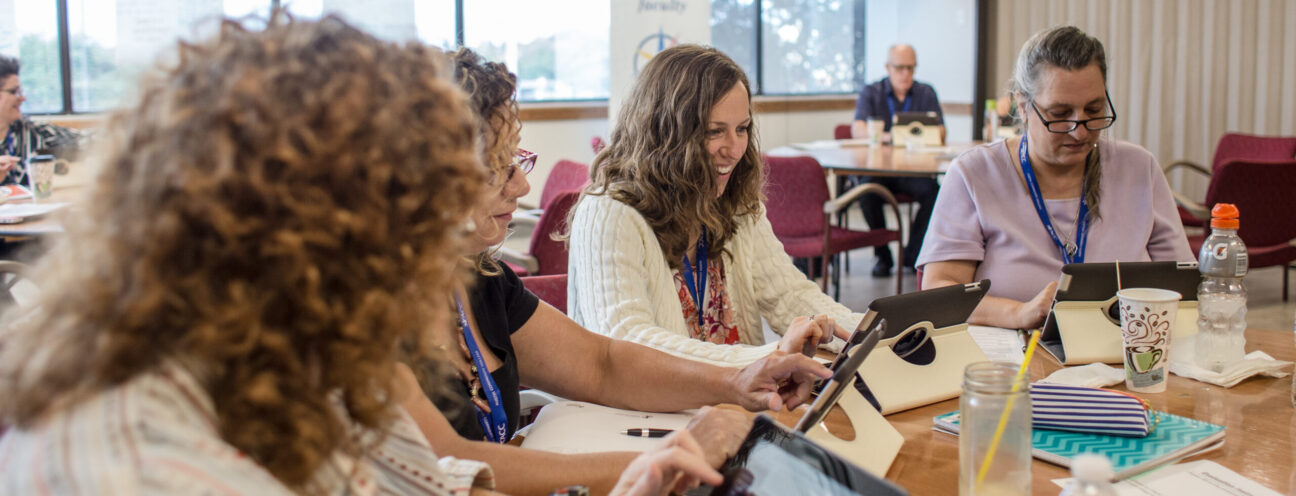
The Office of Distance & Alternative Education offers a diverse range of workshops, designed to enhance teaching and learning in online, hybrid, and HyFlex environments. Key areas of focus include instructional design principles, effective pedagogical approaches, the implementation of innovative technologies, and access to essential college support services.
Required Training:
- Distance Learning Instruction Series (DLIS)
- Online Course Redesign Academy (OCRA) & Applying the Quality Matters Rubric (APPQMR)
Additional Training:
- DE Accessibility Training
- Google Workspace Accessibility (Docs & Slides)
- Microsoft Office Accessibility (Word, PowerPoint)
- PDF Accessibility
- Blackboard Ally: Your Friend in Accessibility
- DE Instructional Design Series
- DE Faculty Learning Communities (FLC)
- Teaching Strategies for All Learners
- DE Institutes
- 8-Week Course Design & Teaching Strategies
- Blackboard Ultra Training
- DE Self-Paced Training Courses
Archived Training:
Assessments:
Each tab includes a description and a recording of the session
Ranked Multiple Choice: More Authentic Online Assessment
Presented by: Herb Coleman
This presentation will present the model of ranked multiple choice as an alternative assessment. The presentation will include data from the implementation of ranked multiple choice in asynchronous classes.
Presented by: Stephanie Long
Help your students improve their digital literacy, showcase their lifelong learning, and reach employers with the content that matters. We will discuss the what & why of ePortfolios, view examples of student work, and review the considerations when implementing ePortfolios across your curriculum. Then we will take a look at the tools currently available at ACC for developing an ePortfolio and build a few quick websites together.
Sharing Alternative Ideas for Student Assessment
Presented by: Larry Stephens and Michelle Costanzo
This session will be an interactive and engaging workshop where faculty members will discuss and share ideas about alternative forms of assessment for students to demonstrate mastery of course objectives. The presenters will share types of assessments they have used in their courses to replace the traditional forms of assessment: exams and quizzes. The session will include a discussion of the advantages and disadvantages of nontraditional forms of assessment and how they can be modified for use in different areas of study.
DE Faculty Connections: DE Course Assessment and Proctoring Logistics
Presented by: Marian Moore, Michelle Escudier and Zuleyka Izquierdo
DE IDs and the DE Online Proctoring Team will briefly introduce the policies of ACC online proctoring, online assessments, academic integrity, and grading online. During the session, faculty can share their experiences and ask any questions about online proctoring, assessments and testing issues and concerns.
DE Course Assessment and Proctoring Logistics:
- Online proctoring methods
- Academic integrity and online learning
- Online testing and alternative assessments
- Online grading and providing meaningful feedback
Embracing ChatGPT and AI with Best Authentic Assessment Strategies
Presented by: Michelle Escudier, Marian Moore and Silke Morin
As AI-transformers like ChatGPT continue to advance, community colleges face the challenge of ensuring academic integrity while providing quality, growth-oriented learning experiences. However, this rise in AI technology also presents a unique opportunity to transform traditional assessment practices and redefine the way we approach learning. By incorporating authentic assessment strategies, which prioritize student critical thinking and reflection, educators can engage and evaluate students throughout their learning journey in meaningful ways. Join this webinar to discover the best, authentic assessment strategies to foster meaningful learning in the new era of AI.
Using Feedback to Improve Student Engagement and Build Rapport
Presented by: Michelle Escudier and Athena Lemus-Wilson
Feedback can be used to celebrate success, acknowledge effort, and support student self-assessment. This session will focus on how to give feedback that improves student engagement and rapport and discuss the technology tools that support it. We will discuss the nature of feedback, stereotyping threats, and how to give feedback. We will discuss recommended best practices for feedback based on the Universal Design of Online Learning from CAST.
Crafting Clear Evaluation Criteria: Empowering Learners through transparent assessment Criteria
Presented by: Jennifer Gray and Kayla Beltran
We understand that students’ comprehension of how they will be assessed significantly impacts their learning experience. In this workshop, we will dive into the essentials of designing criteria that empower learners by providing clarity and direction. Specific Review Standard 3.3 has the highest “not met” during Quality Matters course reviews. This essential standard emphasizes the provision of specific and descriptive criteria for the evaluation of learners’ work, ensuring a transparent connection to the course grading policy. Understanding how to design comprehensive evaluation criteria that guide learners and facilitate precise grading is crucial. Join us as we explore the reasons behind the “not met” evaluations during course reviews and equip faculty with the tools and strategies to elevate their courses to meet this critical standard.
How Writing in the Discipline Improves Equity and Student Experiences
Presented by: Amber Clontz
The English Department has created a guiding document to help instructors reduce student reliance on AI. This presentation will share those guidelines by way of explaining how multimodal writing assignments authentic to a discipline can accomplish the same ends, improving equity and student experiences with learning assessments.
High-Impact Practices (HIP): Boosting Student Engagement and Career Readiness through Course Design
Presented by: Marian Moore and Mavis Klemcke
In this 60-minute workshop, we will define High-Impact Practices (HIP) and discuss how to boost student motivation and career readiness in your online course design. We will also discuss how to create a course map that aligns your assessments and activities to help students connect their learning to the world beyond the classroom. In addition, we will explore how to leverage the United Nations Sustainable Development Goals to help students identify global and local challenges. Participants will take part in this interactive workshop to explore meaningful ways to approach high-impact learning experiences remotely.
Presented by: Angelo Caverte and Marian Moore
In this 60-minute workshop, we will take a look at what a rubric is, what are its uses, how to create them, and how to add or embed them in your Blackboard assessments.